


What UK Homebuyers need to know
If you are looking to buy a home and you have children, or maybe you plan to - then you will know that the school down the road can matter just as much as how many bedrooms and if it has a south facing garden.
"is this in the catchment for this school" is one of the first questions that estate agents report viewers asking.
Catchment areas are often misunderstood, they are not fixed lines on a map, one side of the street could be within the catchment and the other not but another big consideration to remember, just because you are living within the catchment area, it does not mean that you are guaranteed space at the school.
We'll take a look at what you need to know, before you fall in love with the house.
What is a school catchment area?
A catchment area is a defined patch around a school. If you live within this are then you are usually given priority for a space in the school when you apply.
Not every catchment are works within the same way, whilst it is usually post code driven, this can sometimes mean that one end of the street is within the catchment area but the other side is not.
Each county or council may differ in the way that they define and calculate a "catchment" area:
Mapped catchment or priority areas:
A set zone drawn by the council or school
Distance only:
No fixed zone, places go to the children who live closest
Feeder schools:
Priority for children already at a linked nursery or primary school
Just a reminder that not every school uses a catchment area, so always check rather than assume.

Catchment is just one part of the picture
When a school is full, places are usually handed out in the order set by it's admission criteria. Living in the catchment will move you up the list but nothing is guaranteed.
In England, children with an education, health and care (EHC) plan naming the school must be admitted to the school and looked after. After that, each school or council sets it's own order. Here are some common reasons - a brother or sister at the school, following a prticular faith (at faith schools), attending a named feeder nursery or primary and for some schools, passing an entrance test such as the 11 plus.
This will vary school by school, council by council and rules vary across the UK, so Wales, England, Scotland and Northern Ireland will have different rules.
Why the line moves and what it needs for your budget
Where a school allocates by distance, there is no permanent boundary. The catchment is set each year by the "last distance offered" which is, how far away the last child to get a place under the distance rule lived.
The figure shifts with demand, for example - a year with lots of siblings applying leaves fewer places for distance, so the cut-off shrinks. A house that was next comfortably in a catchment last year could fall just outside it this year.
How distance is measured matters too, whilst some councils will use a straight line from the school to your home, others may use a walking route. The same house will then have different answers, depending on the method they use.
You also have to consider price. Homes in catchment for popular schools are in high demand and buyers will often pay "over the odds" for it.

Common catchment myths
If I am in a catchment, I am guaranteed a place
Not true. Catchment areas can raise your chances but it will never guarantee a place.
I can only apply to my catchment school
Not true. You can apply to schools outside of your catchment and actually, a different area or council ward.
I'll just use a relative's address
Don't. Councils check addresses and a place won through a misleading application can be withdrawn, even if your child has started the school.
Catchment's never change
Not True. Catchment areas can and do change.
Check Catchment in seconds with Planna
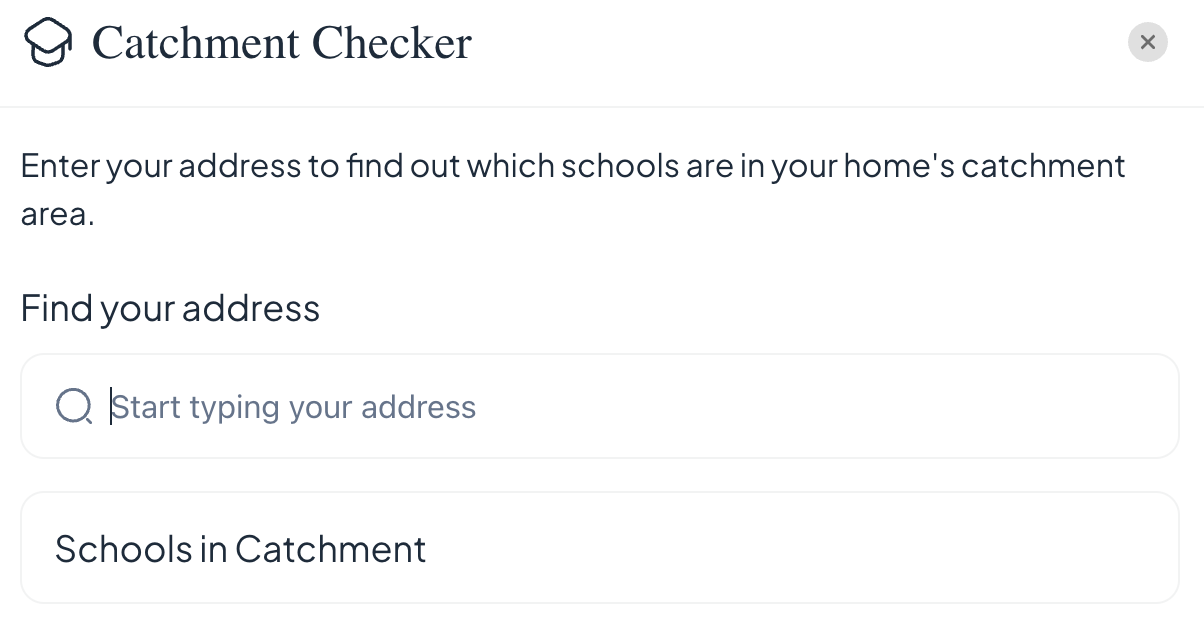
Digging through council websites for every property on your shortlist will take time, especially during the property search. Planna have created a catchment checker, covering the whole of the UK.
Pop in your address and see what school catchment, your home falls into. You can rule out going to view a property if you know that getting into a certain school, is a priority for you. Once you've checked out your catchment area on the Area Guide - you can explore everything from how many cafe's are nearby to the crime that the area gets - this will really give you an understanding of the area you are buying. Planna also have a property report - this will give you information on a specific property from running costs and EPC ratings to maintenance budgets.
Catchment information is a guide, and it is never a guarantee of a school place. Always confirm admission arrangements with the school or local council before you commit.


