


And why does it matter when you are buying or selling a property?
Ask most homeowners what their house is "worth" and they'll give you a number pulled from online valuation tools. Ask them what condition it's actually in and you'll usually get a shrug, or a list of the two or three things they know need fixing, followed by "probably fine otherwise."
That gap between price and condition is exactly where a home condition score sits. It's not a valuation. It's not an EPC rating, though it overlaps with one. It's a single, comparable number that answers a question most people never get a straight answer to until it's too late to act on it: how healthy is this property, really?
With HomeScore, that question gets a proper answer, and heading into autumn, one of the busiest moving windows of the year after spring, it's worth understanding what the score is actually built from, why it carries more weight at resale than most sellers assume, and how buyers, sellers, landlords, and tenants can all put it to use before the market gets busy.
What a home condition score actually is
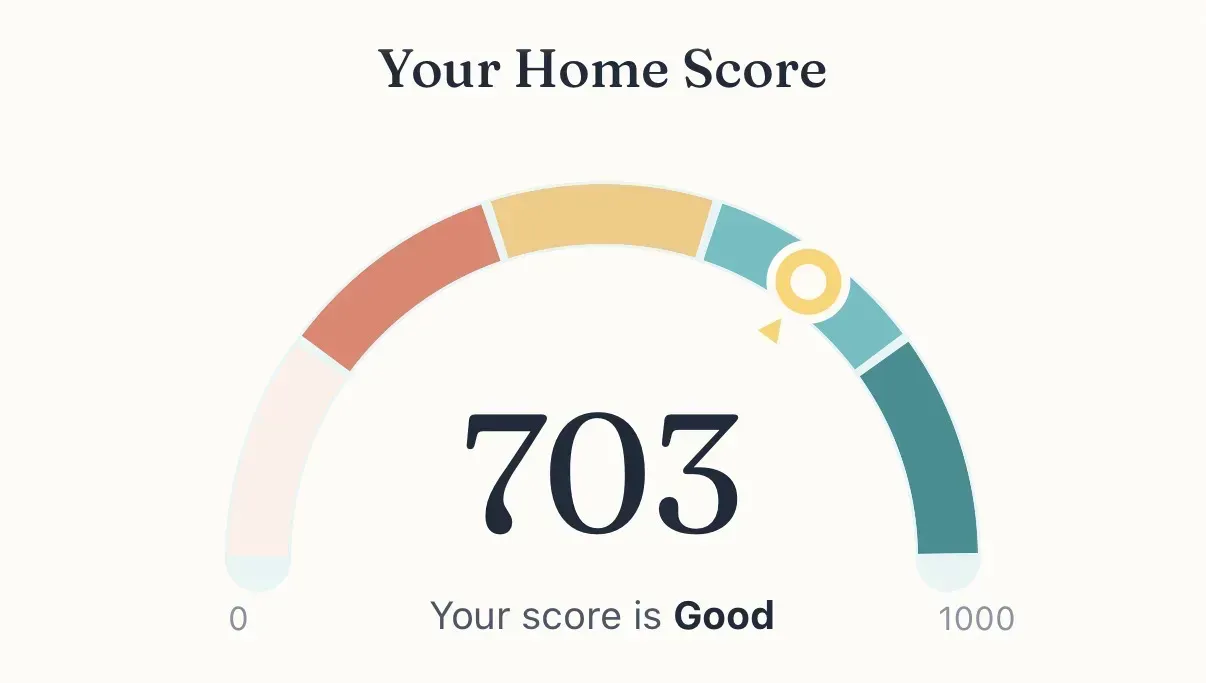
A condition score takes the dozens of individual things that make up a property's health, structural integrity, energy performance, ongoing running costs, maintenance history, even location-based risk, and compresses them into one figure. Think of it less like a school report card and more like a credit score: a single number that stands in for a much larger, messier set of underlying data, built specifically so that someone who isn't a surveyor can still make sense of it at a glance.
HomeScore does this by pulling together thousands of data points on a property and running them through Planna's own analysis models to produce a score that updates as the home changes, not a one-off snapshot that goes stale the moment it's issued. That's the detail people miss: a condition score isn't a certificate you file away, it's closer to a live health tracker. Fix the roof, and the score should move. Let the boiler run past its service date, and it should move the other way too.
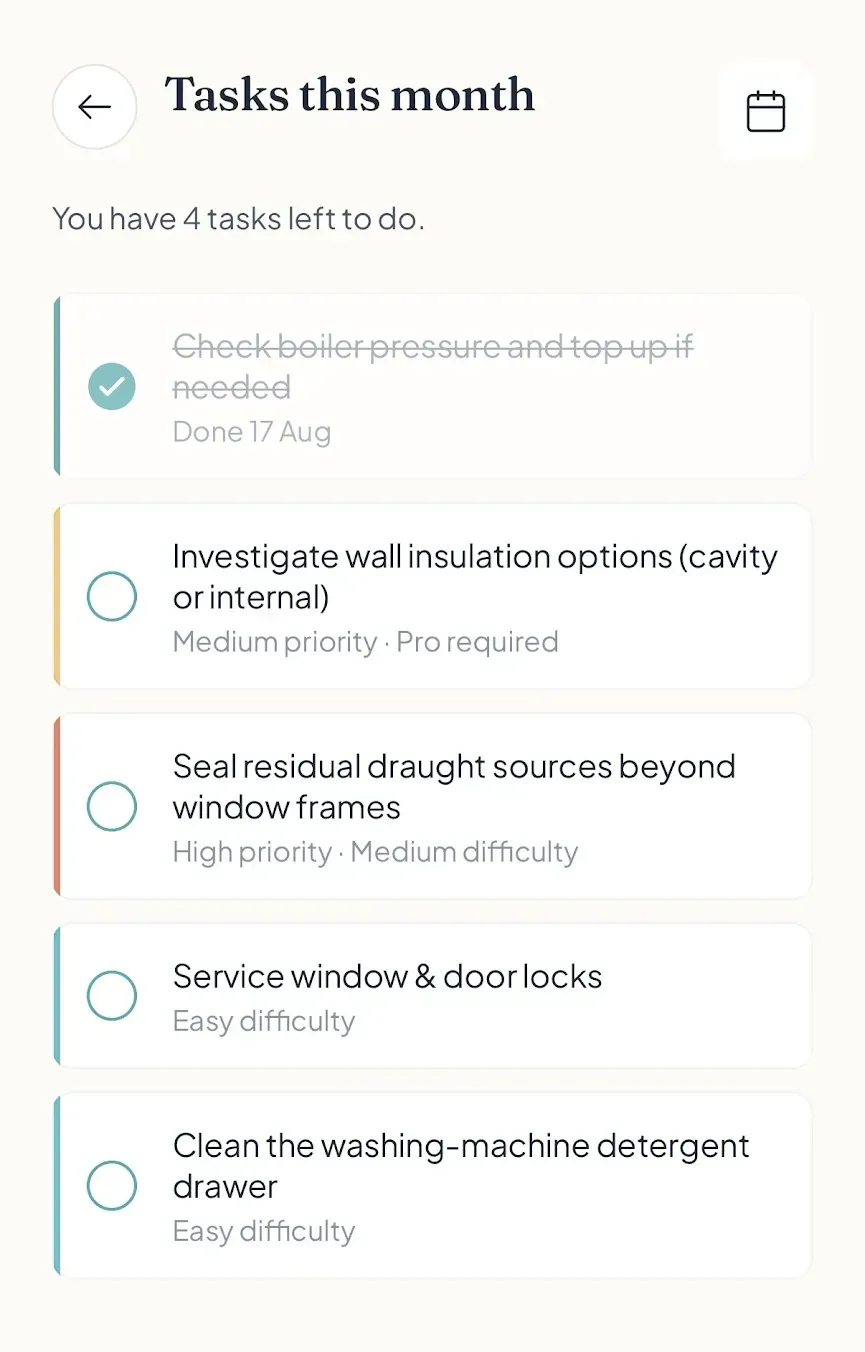
It also doesn't stop at the number. Each month, HomeScore turns the score into a set of tasks based on what the property actually needs and what the user is trying to get out of it, whether that's cutting energy bills, moving toward a greener home, staying ahead of maintenance, or getting ready to sell. Two homes with an identical score can end up with completely different task lists, because the point isn't just to measure condition, it's to move it in whatever direction the homeowner cares about.
That distinction matters because most of what currently exists in the UK property market is static. An EPC is valid for ten years and often doesn't reflect a single improvement made after the assessor leaves. A building survey is a snapshot from one visit, priced for a single transaction, and rarely looked at again once the sale completes. A condition score is designed to be the opposite: something a homeowner checks in on, not something they commission once and forget.
What actually goes into the score
Five things tend to carry the most weight, and they're worth understanding individually because they pull in different directions. A home can score well on one and badly on another, which is exactly the kind of nuance a single "great condition!" listing description hides.
Physical condition. This is the closest thing to a traditional survey: the age and state of the roof, walls, windows, damp, subsidence risk, and anything structural. It's the category most buyers assume a condition score is entirely about, and it's usually the biggest single factor, but it's rarely the only one that ends up mattering.
Energy efficiency. Overlapping with, but not identical to, an EPC rating. Insulation quality, glazing, heating system age and efficiency, and how well the building actually retains heat in practice rather than on paper. A property can hold a decent EPC band and still perform poorly here if the certificate is old or the assessment was generous.
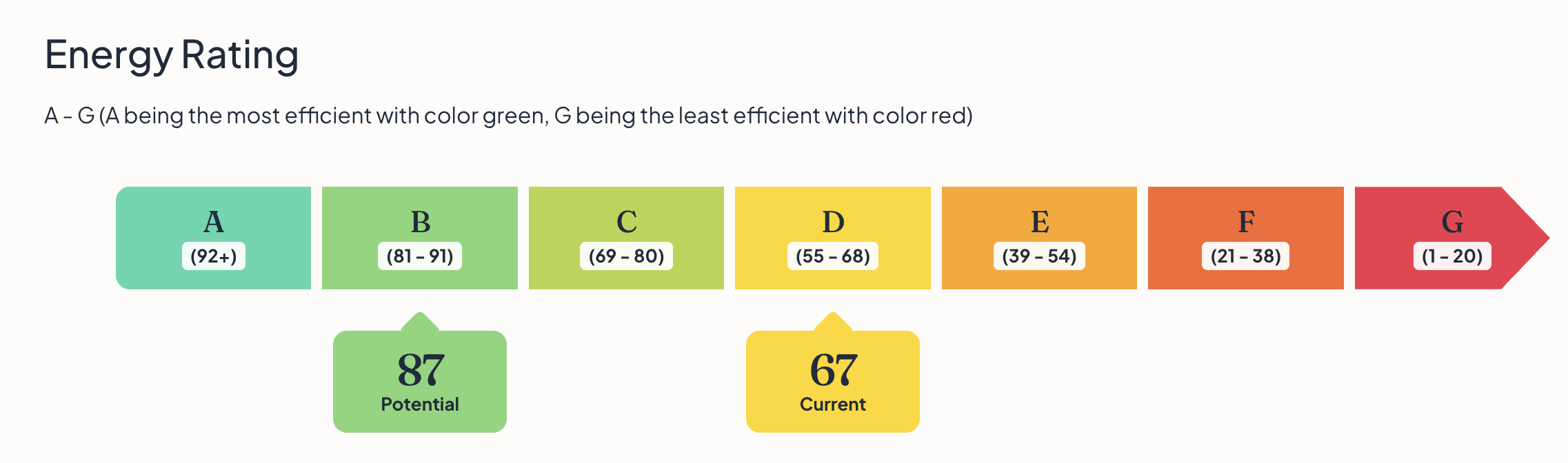
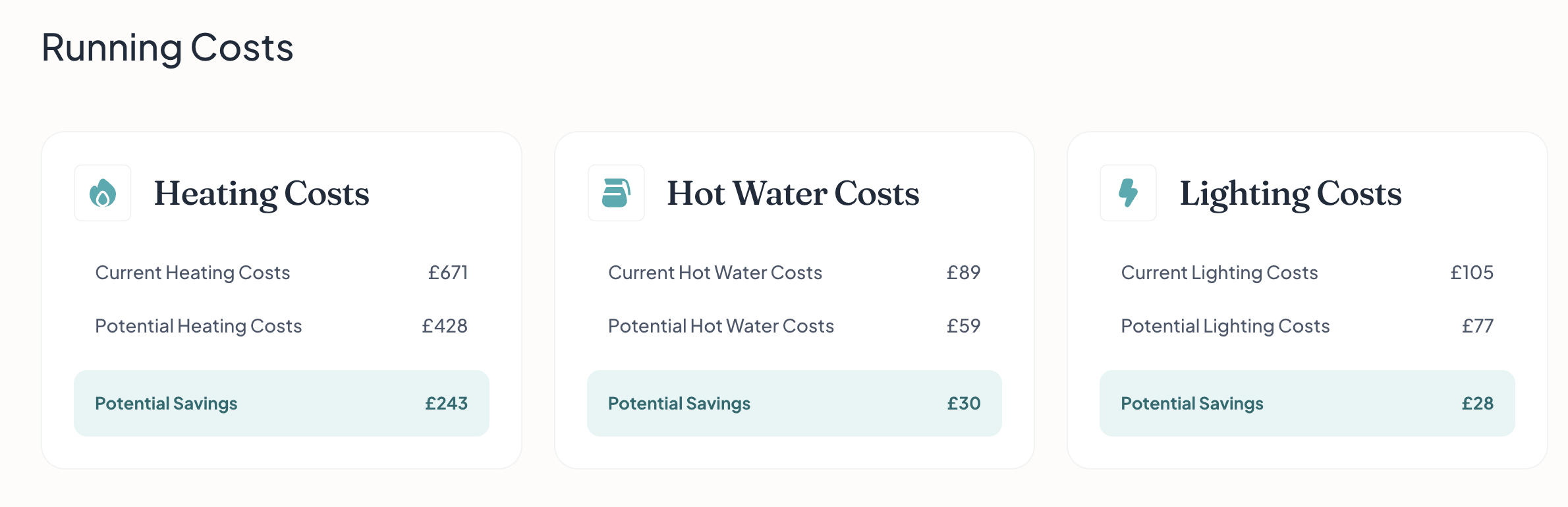
Running costs. How much it actually costs to live in the property day to day, factoring in heating, water, and maintenance patterns rather than just the headline energy rating. Two homes with identical EPC certificates can have very different real-world running costs depending on how the building actually behaves.
Maintenance history. Whether things have been looked after on a schedule or fixed reactively when they broke. A boiler serviced annually for a decade tells a very different story to one that's never been serviced but "still works fine," even though both might pass a viewing.
Location-based risk. Flood risk, subsidence risk in the local ground conditions, and other environmental factors that affect a property regardless of how well it's been maintained. This is the factor sellers have the least control over and buyers most often overlook until an insurer or lender flags it.
None of these five exist in isolation, and that's really the point of scoring them together rather than separately. A structurally sound Victorian terrace with single glazing and an aging boiler might score well on physical condition and poorly on running costs. A new-build with excellent energy performance but a subsidence-prone plot might score well on efficiency and badly on location risk. A single "condition" label from an estate agent would flatten both of those into the same word. A score doesn't.

Why it matters more at sale than people think
Most sellers assume condition only matters if something is visibly broken. Fix the obvious stuff, tidy up for viewings, and the rest sorts itself out in negotiation. That's true right up until it isn't, and the moment it stops being true is usually during the buyer's mortgage valuation or survey, well after an offer has already been accepted.
This is where condition scoring earns its place as more than a nice-to-have. A poor condition score rarely kills a sale outright, but it reliably reshapes the negotiation. Buyers who commission a survey and find issues that weren't disclosed upfront don't just ask for a price reduction, they lose confidence in everything else about the property they were told. A seller who can point to a documented, up-to-date condition score before a single viewing has happened is doing something subtly different: they're removing the information asymmetry that buyers exploit to renegotiate late in the process.
There's a second, less obvious angle, and it's becoming more relevant as lenders and insurers pay closer attention to property-level data rather than just postcode-level averages. A well-maintained property with a documented history is, in principle, a lower risk to insure and a safer asset to lend against, and a verified condition score gives homeowners a way to demonstrate that rather than just assert it. That's still an emerging part of the market rather than standard practice everywhere, but the direction of travel is clear: the more evidence a homeowner can produce about how well a property has actually been looked after, the more that evidence is worth something concrete, whether that's a smoother remortgage, a stronger case for an energy efficiency grant, or simply a buyer who doesn't feel the need to chip 5% off their offer just in case.
Put simply, condition scoring shifts the moment of truth. Instead of the buyer discovering the real state of the property during their survey and using it as leverage, the seller already knows, and can either fix what's fixable before listing or price accordingly from day one. That's a meaningfully different negotiating position, and it's one very few sellers currently occupy because the information simply hasn't been available to them in an accessible form until recently.
Why the autumn window makes this more urgent
Spring gets most of the attention as the UK's peak moving season, but autumn, roughly September through November, is consistently the second busiest, driven by families wanting to move before Christmas and buyers who started looking in spring finally completing in time for the new school year. It's also, not coincidentally, the season when a lot of the physical issues a condition score picks up become impossible to ignore: roofs and guttering show their summer wear right as the weather turns, damp and condensation become obvious as heating goes back on, and boilers that limped through summer either get serviced properly or fail at the worst possible moment.
That timing cuts both ways. For sellers, listing in September or October means viewings happen exactly when a property's weak points, an underperforming boiler, a draughty window, a damp patch that only shows up once it's cold, are most visible to a buyer standing in the room. Knowing your score ahead of listing means you can either address the issues that would show up anyway or set expectations and pricing accordingly, rather than finding out from a buyer's survey after you've already agreed a price. For buyers, it means viewings this season are actually a better test of a property's real condition than a dry, mild spring viewing would be. A home that still feels warm and dry on a cold October evening has told you something a March viewing never could.

It isn't just for buying and selling
Most of the attention condition scores get is tied to transactions, but the rental market has just as much reason to use one, arguably more, now that the Renters' Rights Act has changed what landlords are expected to prove and what tenants are entitled to ask for.
For landlords, a documented score does two things a checklist never could. First, it gives an ongoing record of a property's condition and running costs, which matters directly for Minimum Energy Efficiency Standards: rental properties need to reach EPC C by 2030, and a live condition score makes it far easier to plan and budget for that improvement over several years rather than scrambling in year nine. Second, it protects landlords when a tenancy ends. A dated, third-party record of the property's condition at the start of a tenancy is worth far more in a deposit dispute than a memory of "it was fine when they moved in."
For tenants, the value runs the other way. Renters rarely get any independent view of a property's condition before signing a tenancy agreement, they're relying almost entirely on what the landlord or agent tells them and what's visible on a single viewing. A condition score gives a tenant an objective baseline, something to compare against later if a boiler starts failing, damp appears, or repairs are slow to happen. Under the Renters' Rights Act, tenants have stronger grounds than before to push back on properties that fall short, but that only works if there's evidence to point to. Not "the flat felt cold all winter," but a documented score change from move-in to eight months later.
Common questions
Is a condition score the same as an EPC rating? No. An EPC only measures energy efficiency, and it's valid for ten years regardless of what happens to the property in between. A condition score covers energy efficiency as one factor among several, alongside physical condition, running costs, maintenance history, and location risk, and it's designed to update as the property changes rather than stay fixed for a decade.
Does a low score mean a property won't sell? Not usually. A low score is far more likely to affect price and negotiating position than whether a sale happens at all. Most issues that pull a score down, an ageing boiler, patchy loft insulation, gutters that need clearing, are common and fixable rather than deal-breaking. The risk isn't the score itself, it's a buyer discovering the same issues later, unprompted, during their own survey.
Who is a condition score actually for, buyers or sellers? Both, and often at the same stage of the same transaction. A seller uses it beforehand to know what they're presenting and price accordingly. A buyer uses it during their search to compare properties quickly and decide where a fuller survey is worth the spend. And a renter, landlord and someone living in a property can use it in the same way.
Is a condition score only useful when buying or selling? No. Landlords use it to plan energy efficiency upgrades ahead of MEES deadlines and to document a property's condition in case of a deposit dispute, and tenants use it to get an independent read on what they're actually moving into, and a record to point back to if things go downhill during the tenancy.
How often should a homeowner check their score, not just when selling? At least monthly. HomeScore sets a fresh set of tasks every month based on the property's condition and whatever the homeowner is actually trying to achieve, whether that's cutting bills, moving toward a greener home, or just staying on top of maintenance, so checking in isn't a one-off event, it's built into how the tool works. That regular rhythm also means small issues get caught while they're still cheap to fix, and the effect of upgrades like new insulation or a boiler replacement is actually visible rather than assumed.
The bottom line
A condition score won't tell anyone everything about a property, and it was never meant to replace a proper survey or independent legal advice. What it does is close the gap between how a home looks on a viewing day and how it's actually performing underneath, and it does that in a format everyone with a stake in the property, buyers, sellers, landlords, and tenants alike, can actually use rather than a report that sits in a drawer after completion.
Heading into the autumn moving season, that gap matters more than usual. Properties are being judged in weather that exposes their real condition, buyers are moving faster to secure homes before the year end, and sellers who understand their property's score before anyone else does are simply negotiating from a stronger position. Whether you're listing this autumn, about to make an offer, letting a property out, or moving into a rental, it's worth knowing your number before someone else finds it for you.
Check out your HomeScore via our app


