



Based on the North commute.
The northern commuter belt above London has quietly become one of the most competitive property landscapes in England. Stretching across Hertfordshire, Bedfordshire, and into the Cambridgeshire fringe, it combines fast rail access into the capital with market towns, village communities, and some of the strongest-performing family housing markets in the country. But while many people focus on schools, trains, and property prices, one factor increasingly shaping buying decisions is safety and the data shows that not all commuter towns perform equally.
Using rolling 12-month police-recorded crime datasets at ward level, a clear pattern emerges across the northern commuter corridor. The safest areas are overwhelmingly the ones that sit slightly outside the busiest urban centres: lower-density neighbourhoods with strong owner-occupancy, stable populations, and limited nightlife or heavy through-traffic.
These are five of the standout performers.
Understanding Safety in the Northern London Commuter Belt
The geography north of London creates a natural crime divide. Larger hubs such as St Albans, Luton, Stevenage, and Cambridge generate higher recorded incident volumes because of density, transport interchange, retail activity, and commuter footfall. But surrounding them are smaller neighbourhoods and suburban fringes where the crime profile changes dramatically.
The safest neighbourhoods typically share the same characteristics:
- Long-term residential populations
- Higher owner-occupancy rates
- Strong school catchments
- Semi-rural or suburban layouts
- Limited evening economy activity
That combination creates stable, consistently low crime figures over time.
Harpenden South
Harpenden South recorded just 185 crimes in 2025, making it one of the lowest-crime commuter neighbourhoods anywhere within easy reach of London.
Harpenden has long carried a reputation as one of Hertfordshire’s most desirable towns, but the southern section stands out even within the town itself. Tree-lined residential streets, high owner-occupancy, and exceptionally strong school catchments all contribute to a very stable local environment.
Unlike many commuter towns, Harpenden avoids the intensity of a large nightlife economy or major commercial centre. The result is a crime profile that remains consistently low despite direct Thameslink access into central London.
What makes Harpenden South particularly notable is not just the low figure itself, but how consistently it performs year after year.

Codicote & Kimpton
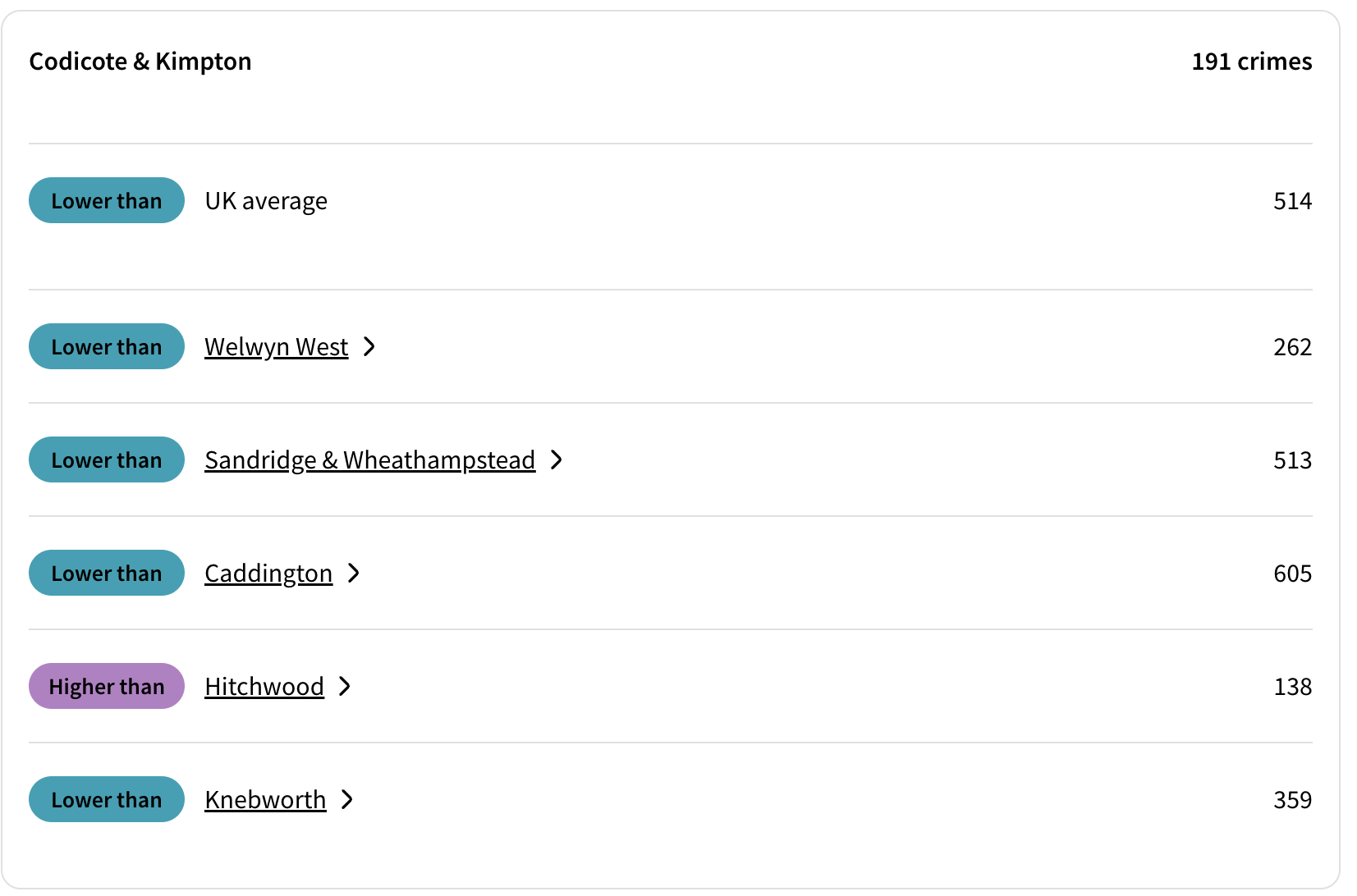
Codicote and Kimpton continue to quietly outperform almost every surrounding commuter ward when it comes to safety.
With 191 recorded crimes in 2025, this remains one of the strongest low-crime rural commuter locations north of London. The ward is built around small village settlements separated by green belt countryside, which naturally limits density and transient activity.
There is very little in the way of concentrated retail, nightlife, or transport interchange — all factors that typically elevate recorded crime elsewhere. Instead, the area is dominated by detached housing, village high streets, farmland, and long-established residential communities.
It is effectively the “green belt effect” in action: once you move outside the main commuter hubs, crime levels drop sharply.
Aspley & Woburn
Aspley Guise and Woburn recorded 194 crimes in 2025, placing them firmly among the safest commuter-belt neighbourhoods in the northern corridor.
This area benefits from a rare balance: rural surroundings combined with excellent connectivity via nearby Milton Keynes and fast rail routes into London. Despite that accessibility, the ward retains a distinctly village-led character, with woodland, open countryside, and low-density housing shaping much of the environment.
Woburn in particular has an unusually controlled feel compared to many commuter settlements, helped by conservation protections and limited overdevelopment. Crime figures here tend to remain low not because the area is isolated, but because activity levels remain manageable and highly residential in nature.

Hitchin Highbury
Hitchin Highbury recorded 245 crimes in 2025, making it one of the strongest-performing suburban neighbourhoods within a larger commuter town setting.
Unlike the more rural entries above, Highbury sits within Hitchin itself — a far busier and more active market town. What makes this ward stand out is its balance: close enough to benefit from the town’s amenities and rail links, but residential enough to avoid much of the town-centre crime concentration.
The area is characterised by:
- Strong family housing stock
- Stable residential streets
- Lower-density suburban layout
- Good separation from commercial corridors
Hitchin overall performs relatively well compared to many commuter towns of similar size, but Highbury consistently sits among its safest sections.
Royston Meridian
Royston Meridian recorded 257 crimes in 2025, rounding out this group of consistently low-crime northern commuter neighbourhoods.
Royston occupies an interesting position geographically: close enough to Cambridge to benefit from economic spillover, but still functioning primarily as a quieter market town rather than a dense urban centre.
The Meridian ward reflects that character clearly. Crime levels remain relatively low due to a combination of suburban housing, limited nightlife, and a settled commuter population. While Royston sees regular rail movement into both London and Cambridge, it avoids many of the pressures associated with larger interchange towns.
For buyers seeking a balance between affordability, connectivity, and safety, Royston continues to attract attention precisely because it sits slightly outside the more overheated commuter hotspots further south.

Conclusion
Across the northern commuter belt, the safest neighbourhoods follow a remarkably consistent pattern. The strongest-performing neighbourhoods are either:
- village-led rural communities surrounded by green belt land, or
- stable suburban pockets within established commuter towns
Harpenden South and Codicote & Kimpton sit at the very top end of the spectrum, recording exceptionally low crime figures for areas still within practical reach of London. Aspley & Woburn demonstrate how rural Bedfordshire continues to quietly outperform more heavily urbanised commuter zones, while Hitchin Highbury and Royston Meridian show that larger towns can still contain highly stable residential neighbourhoods.
The broader lesson is clear: within one hour of London, safety is shaped less by prestige alone and more by structure — density, movement, and the extent to which a neighbourhood remains fundamentally residential in character.